How to Choose the Best Warehouse Bollards from China?
Choosing the right Warehouse Bollards from China requires more than comparing unit prices. A loading bay may face forklifts, pallet trucks, carts, and reversing vehicles every hour. OSHA reports that powered industrial trucks cause about 85 work-related deaths and 34,900 serious injuries annually in the United States. That figure makes impact protection a practical investment, not a decorative upgrade.
James Reason, a leading safety researcher, wrote, “We cannot change the human condition, but we can change the conditions under which humans work.” His principle applies directly to warehouse protection. Effective bollards create safer conditions by separating people, racking, doors, columns, and machinery from moving equipment. Buyers should examine steel grade, wall thickness, impact resistance, base-plate design, anchor quality, surface treatment, and replacement procedures. Hot-dip galvanizing may suit damp loading areas, while powder coating offers clearer color coding indoors. Details matter.
China offers broad manufacturing capacity, but quality is not uniform. MHI’s annual industry research continues to highlight resilience, labor pressure, and technology investment across supply chains. Therefore, supplier evaluation should include factory audits, material certificates, welding records, load-test evidence, and clear dimensional drawings. Ask for samples.
The cheapest option can become expensive.
A stronger product may still fail if poorly anchored. Installation deserves equal attention. We should also admit one uncomfortable point: no bollard eliminates careless driving. It only reduces the consequences. A reliable sourcing decision combines tested design, verified production, suitable installation, and realistic site experience. That is the foundation for choosing Warehouse Bollards from China with confidence.
Understanding Warehouse Bollards and Their Role in Facility Safety
How to Choose the Best Warehouse Bollards from China?
Understanding Warehouse Bollards and Their Role in Facility Safety
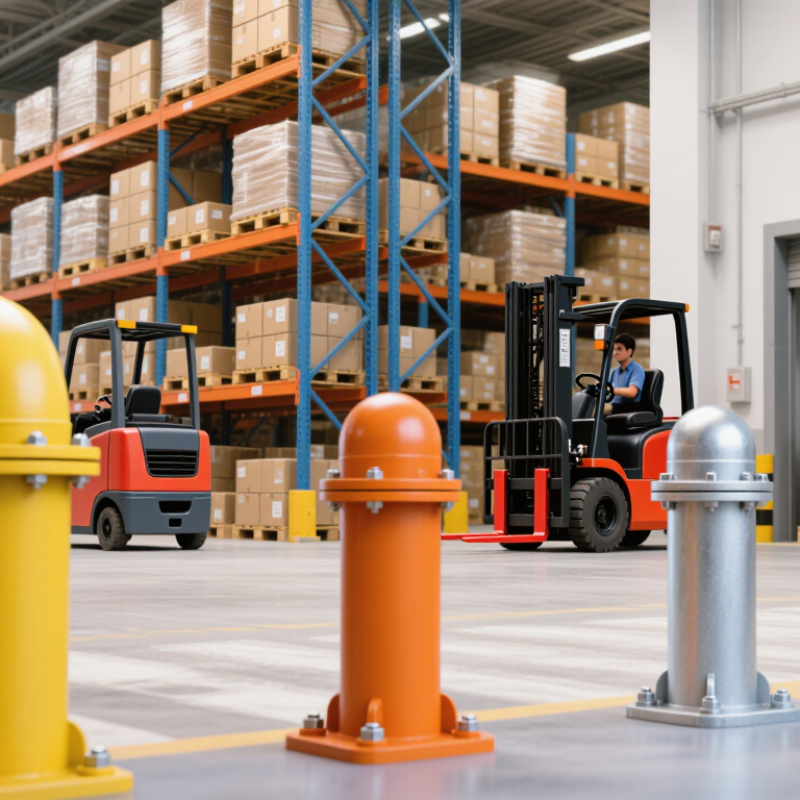
Warehouse bollards are fixed or removable barriers that help protect people, racks, doors, and equipment from vehicle impacts. Think of a forklift turning tightly beside a loading-bay door. A well-placed bollard can create a visible buffer, but it cannot prevent every collision. Its value depends on location, design, installation, and routine inspection.
The U.S. Bureau of Labor Statistics reported a 2022 total recordable injury and illness rate of 4.8 cases per 100 full-time workers in warehousing and storage, compared with 2.7 across private industry. These figures cover many causes, not bollard-related incidents, but they underline the need for layered safety measures.
Choose protection around actual traffic paths and impact risks. Map forklift routes, pedestrian crossings, rack ends, and vulnerable utilities before selecting bollard height, diameter, and spacing. Ask suppliers for material specifications, impact-test details, installation guidance, and corrosion protection suited to the site. A bollard that looks sturdy may still be poorly anchored. Check it regularly for loose fixings, cracks, and damaged coatings. Keep sightlines clear, too.
Tips: Match bollard placement to the hazard, not just the floor plan. Confirm that anchors suit the concrete slab, and leave enough clearance for doors and vehicles. Bollards support safe operations; trained drivers, marked routes, and clear aisles still matter.
Identifying the Hazards and Protection Needs in Your Warehouse
How to Choose the Best Warehouse Bollards from China?
Identifying the Hazards and Protection Needs in Your Warehouse
Before comparing bollards, walk the warehouse during a busy shift and map where vehicles, people, and equipment cross paths. Look closely at rack ends, loading doors, pedestrian entrances, charging areas, and exposed utility lines. Small impacts matter. A bent rack foot or chipped concrete can signal repeated contact, even when nobody reports a collision.
Match protection to the actual hazard. Forklift traffic near a rack may need a different barrier from a doorway exposed to pallet trucks. Record vehicle types, typical speeds, turning space, impact height, and how often traffic passes each point. Measure aisle clearance, too; a bollard that protects a column but obstructs a tight turn creates another risk. I have seen protection plans miss this detail. It is easy to overlook.
Then decide what each location must withstand and what must remain accessible. Fixed steel bollards can suit permanent hazards, while removable or flexible designs may fit changing work areas. Ask suppliers for material specifications, dimensions, finish details, installation guidance, and relevant test documentation. Check whether the proposed base and anchoring method suit your floor thickness and condition. Concrete quality varies. If site measurements are uncertain, verify them before ordering; a confident estimate is still an estimate.
How to Choose the Best Warehouse Bollards from China?
Identify the warehouse zones with the highest combination of impact likelihood and consequence before selecting bollards. Loading docks, forklift aisles, and storage-rack corners generally require the strongest protection because they are exposed to frequent vehicle movement and costly structural damage.
Comparing Bollard Materials, Designs, and Installation Options
Choosing warehouse bollards from China requires more than comparing prices. Material selection should follow the impact environment. Galvanized steel offers strong resistance and suits loading bays, forklift lanes, and outdoor storage areas. Stainless steel resists corrosion better, but usually costs more. Flexible polymer bollards absorb lighter contact and reduce vehicle damage, though they may fail under repeated heavy impacts. FM Global Data Sheet 1-23 identifies vehicle impact as a recurring property-loss exposure and recommends evaluating vehicle mass, speed, and approach angle.
Design matters equally. Fixed bollards provide dependable protection around columns, doors, and racking ends. Removable models support access changes, but their sockets need careful cleaning and inspection. High-visibility coatings improve recognition in low-light aisles. OSHA 29 CFR 1910.176(b) requires protection where material-handling hazards exist, making placement more important than decoration. A bollard that looks strong may still protect the wrong point.
Installation affects real performance. Surface-mounted units allow faster replacement and less floor disruption. Embedded bollards usually provide stronger resistance, but they require accurate drilling, concrete assessment, and curing time. Ask Chinese suppliers for steel grade certificates, coating thickness records, impact-test evidence, dimensional drawings, and factory inspection reports. I would not accept a generic “heavy-duty” claim. That phrase is too vague. In practice, I have seen projects overprotect open spaces while leaving rack corners exposed. Recheck forklift routes, turning radii, anchor spacing, and maintenance access before approving the final layout.
Evaluating Chinese Manufacturers, Standards, and Quality Controls
How to Choose the Best Warehouse Bollards from China?
Evaluating Chinese Manufacturers, Standards, and Quality Controls
A capable Chinese manufacturer should explain its steel grade, tube thickness, base plate design, and anchoring method clearly. Avoid vague claims such as “heavy duty” without test evidence. Request material certificates, welding procedures, coating records, and dimensional inspection reports. ISO 9001 certification is useful, but it does not replace product testing.
Check whether the bollard suits your actual warehouse risks. A forklift impact differs from a pedestrian barrier requirement. Ask for independent impact-test reports under relevant standards, such as ASTM or EN methods, when applicable. Confirm the tested height, vehicle mass, speed, and mounting surface. A report for one model may not cover another model. This detail is often missed.
Factory quality control should include incoming steel inspection, weld checks, coating-thickness readings, and final sampling. Ask for serial numbers or batch records. A video tour helps, but it proves little alone. I would inspect a pre-production sample before approving a large order. Measure tube walls with calipers, check weld consistency, and examine anchor holes for clean alignment. Some suppliers respond quickly but document poorly. That is a warning, not an automatic rejection. Clear corrective-action records matter more than polished presentations. Allow room for review. Warehouse conditions, floor strength, traffic speed, and installation errors can still reduce protection.
Selecting Bollards Based on Cost, Durability, and Maintenance Needs
When comparing warehouse bollards from China, look beyond the unit price. Freight, unloading, installation, and replacement parts can change the real cost. Ask for dimensions, steel-wall thickness, base-plate details, and finish specifications in writing. A sample can reveal rough welds or uneven coating before a large order is placed. A low quote can still be the wrong choice.
Durability should match the actual risk. A bollard near a busy forklift aisle may need heavier steel and secure anchoring than one protecting a quiet storage corner. Check whether the coating suits indoor conditions, especially where floors are washed often or moisture collects near loading doors. Request clear product data and, where available, test information that matches the intended use. More steel is not automatically better if the design or installation is unsuitable.
Maintenance needs affect long-term value. Smooth, intact coatings are easier to clean and inspect; chipped areas may need prompt touch-up to limit corrosion. Include periodic checks of anchors, welds, and visible impact damage in routine site inspections. Small details count. Still, maintenance estimates can be imperfect: traffic patterns change, and a single collision may alter the schedule. Choose a supplier that can answer technical questions clearly and provide consistent specifications for repeat orders.