Why Choose a Tugboat Fender for Marine Protection?
Marine terminals depend on reliable tug operations to move large vessels through narrow, high-risk waters. UNCTAD’s Review of Maritime Transport reports that about 80% of global merchandise trade by volume travels by sea. Every contact between a tug and a ship therefore deserves careful protection. A Tugboat Fender helps absorb impact energy, reduce hull damage, and support controlled vessel positioning during berthing, escorting, and pushing operations.
The right system is not simply a thick rubber tube. PIANC guidance on fender systems emphasizes energy absorption, reaction force, friction, contact pressure, and installation conditions. These factors matter when a tug works against a steel hull, quay edge, or another vessel. A cylindrical or D-shaped Tugboat Fender must also tolerate repeated compression, twisting, saltwater exposure, sunlight, and occasional contact with oil. Small details matter. A loose chain, damaged end fitting, or incorrect clearance can reduce protection during one critical maneuver.
Operational experience shows that fender performance depends on the entire setup, not only the rubber compound. Designers should review tug size, approach speed, hull shape, contact angle, and local weather conditions. Classification society recommendations can add another layer of technical confidence. Still, no fender is a magic shield. A perfectly calculated specification may perform poorly when maintenance is neglected. This is the uncomfortable part. The best choice combines verified test data, practical inspection routines, and honest review of past contact events. Choosing a Tugboat Fender is therefore a risk-control decision, not merely a purchasing decision.
What Is a Tugboat Fender and How Does It Work?
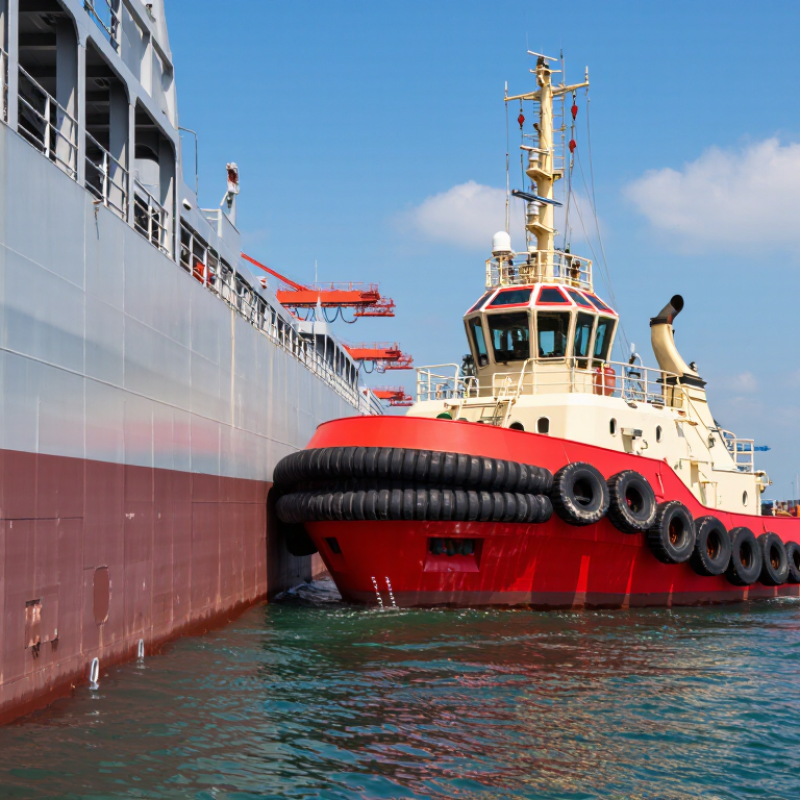
A tugboat fender is a resilient protective barrier fitted along a tug’s bow, stern, or sides. It absorbs impact when the tug pushes, turns, or holds a larger vessel against current and wind. Common designs use solid rubber, cylindrical sections, or foam-filled elements. Their job is simple: reduce peak contact force while preserving useful grip. Not glamorous, but critical.
During contact, the fender compresses and spreads the load across a wider area. This lowers local stress on the tug’s hull and the assisted vessel’s shell plating. Engineers normally assess energy absorption, reaction force, friction, contact pressure, and berthing velocity. PIANC fender guidance highlights these factors as core design checks. Harder is not always safer. Excessive reaction force can damage plating, even when the fender appears durable.
The scale of marine operations explains the risk. UNCTAD’s Review of Maritime Transport 2023 states that over 80% of global merchandise trade by volume moves by sea. Each ship-handling contact therefore deserves controlled protection. A fender’s rated performance must match tug size, contact angle, hull shape, and operating conditions. It should also tolerate saltwater, abrasion, sunlight, and repeated compression. Standards help, but they cannot replace inspection. A design may look correct on paper and still perform poorly when worn, poorly secured, or contaminated with oil. That uncomfortable detail is easy to underestimate.
Types of Tugboat Fenders and Their Marine Applications
Tugboats work in tight, high-contact environments, where a small impact can damage steel plating or harbor structures. UNCTAD’s Review of Maritime Transport 2024 states that about 80% of global merchandise trade by volume moves by sea. That exposure makes reliable contact protection practical, not decorative. A tugboat fender should absorb energy, limit reaction force, and preserve grip during pushing.
Cylindrical fenders suit bow and stern protection during direct contact with larger vessels. Their rounded profile spreads pressure across a wider area.
D-shaped fenders fit side rails and bulwarks, where repeated sideways contact is common. W-shaped fenders provide strong traction on the bow, especially during escort work and ship-assist maneuvers.
Sliding fenders work along rubbing strakes and help reduce drag during angled contact. Pneumatic fenders offer softer, flexible protection for ship-to-ship operations, although they require careful pressure control.
Placement matters as much as material. A hard-working harbor tug may need dense rubber at the bow, softer sections near crew access points, and reinforced fittings around towing gear. PIANC guidance highlights energy absorption, reaction force, shear, and abrasion as key design considerations.
Allianz Commercial’s Safety and Shipping Review 2025 recorded 27 total losses of large ships in 2024. That figure does not measure fender failures, but it shows how unforgiving marine operations remain.
No selection is perfect. Wave angle, hull geometry, towing speed, and maintenance records can change the result. Scratches and compression marks deserve attention. Small damage can become expensive.
How to Select the Right Tugboat Fender
Why Choose a Tugboat Fender for Marine Protection?
How to Select the Right Tugboat Fender
Selecting a tugboat fender starts with the vessel’s actual working conditions. Measure displacement, contact speed, freeboard, and the hull’s strongest contact zones. PIANC MarCom guidance identifies berthing energy as a core design input, calculated from mass, velocity, and hydrodynamic effects. A small speed increase can sharply raise impact energy because velocity is squared. Do not rely on vessel size alone.
Look at fender performance under compression. ISO 17357:2014 specifies testing for high-pressure pneumatic rubber fenders, commonly assessed at 50% deflection. Confirm energy absorption and reaction force at that point. The fender must absorb impact without transferring excessive load into the tug’s side shell. Check diameter, length, chain arrangement, and attachment strength together. One detail is often missed.
Field inspections also matter. A fender rubbing against a rough quay may lose cover strength quickly. Saltwater, sunlight, towing lines, and repeated compression accelerate wear. Choose reinforced construction and inspect valves, flanges, seams, and chains regularly. Record pressure readings before demanding operations. Practical experience suggests that an oversized fender is not automatically safer; it may reduce handling clearance and create higher reaction forces. That shortcut is tempting, but wrong. Review the selection after real operating data becomes available.
Installation, Inspection, and Maintenance Requirements
Why Choose a Tugboat Fender for Marine Protection?
Installation begins with accurate measurements, not guesswork. The fender must match the tug’s hull shape, working draft, and contact zones. PIANC’s Fender Design Guidelines recommend checking berthing energy, reaction force, friction, vessel movement, and environmental loads together. A single rating is not enough. Keep bolts, chains, and backing plates accessible for inspection. Poor alignment can create concentrated pressure near the bow or shoulder.
Inspection should follow a written schedule. Before each operation, crews should look for cuts, hardening, abnormal compression, loose fittings, and trapped debris. A fender can look healthy and still be unsafe. During monthly checks, record dimensions and compare them with installation values. ISO 17357-1:2014 provides testing and quality requirements for pneumatic rubber fenders, including energy absorption and reaction force verification. The same discipline is useful for other fender types, even when the standard does not directly apply.
Maintenance records need clear evidence. Photograph damaged areas, measure wear, and identify repeated contact points. Replace distorted hardware quickly. Do not repair deep tears with unapproved patches. PIANC guidance also stresses that performance depends on the complete fender system, not the rubber element alone. In practice, crews sometimes inspect only after visible failure. That habit needs reconsideration. Weather, saltwater, towing angles, and frequent pushing can accelerate deterioration, so inspection intervals should reflect actual service conditions.
Why Choose a Tugboat Fender for Marine Protection?
Tugboat fenders absorb impact energy during berthing, pushing, towing, and ship-to-ship contact. Proper installation, regular inspection, and timely maintenance help reduce hull damage, improve grip, and extend service life.
Typical inspection schedule: Check the fender before every operation, perform a routine inspection every 30 days, complete a detailed condition inspection every 90 days, and carry out an annual replacement assessment. Actual intervals should follow the fender manufacturer’s instructions, operating conditions, and applicable maritime requirements.
Installation and Maintenance Essentials
- Use correctly sized chains, shackles, bolts, and retaining systems for the expected impact and towing loads.
- Confirm that the fender is securely positioned and does not obstruct propellers, rudders, towing gear, or access routes.
- Inspect regularly for cuts, abrasion, cracking, deformation, hardening, chemical damage, and excessive wear.
- Check ropes, chains, fittings, and attachment points for corrosion, looseness, distortion, or broken strands.
- Replace the fender when damage reduces its shape retention, energy absorption, buoyancy, or secure attachment.