Leave Your Message

Top 10 Locking Bollards for Parking Lots?

Choosing among the Top 10 Locking Bollards for Parking Lots starts with a practical question: what must the bollard control? A staff entrance, a reserved space, and a delivery lane need different levels of access and protection. A key-operated post may suit occasional access. A removable or retractable model can work better where vehicles pass throughout the day. Small details matter: check the lock position, drainage, concrete depth, and clearance for a driver opening a door.

Professional guidance helps separate useful evidence from marketing claims. The International Transportation Engineers’ Parking Generation Manual compiles observed parking-demand data for different land uses. It can inform site planning, but it does not prescribe a bollard count. ASTM F2656/F2656M sets a vehicle-impact test method for perimeter barriers; it should not be mistaken for a rating held by every parking bollard. NHTSA reported 7,522 pedestrian deaths in U.S. traffic crashes in 2022. That figure is not specific to parking lots, but it underscores why vehicle movement and pedestrian routes deserve careful review.

Urban-design expert Jan Gehl’s principle, “First life, then spaces, then buildings—the other way around never works,” is a useful reminder to plan around people, not just hardware. The guide below compares locking mechanisms, materials, installation needs, and everyday usability. Some sites may need less protection than expected. Others need a more careful assessment. The right choice depends on the actual site.
Top 10 Locking Bollards for Parking Lots?

Locking Bollard Categories: Fixed, Removable, Fold-Down, and Retractable

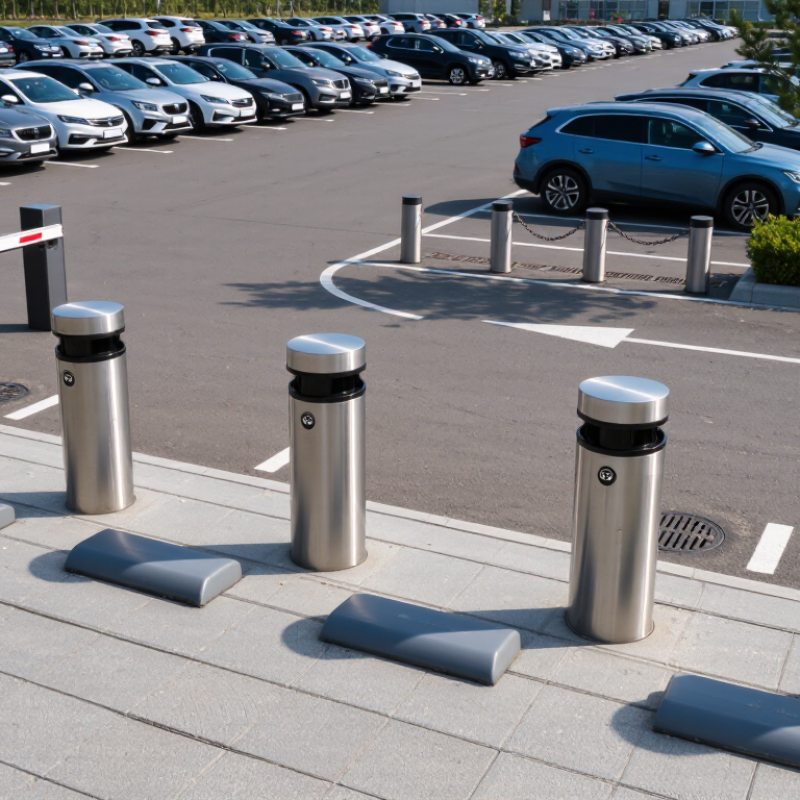
Locking bollards differ mainly in how they manage access. Fixed posts provide a constant barrier, but they can complicate delivery access and maintenance. Removable bollards lift from ground sockets, making occasional vehicle entry possible; the sockets need regular cleaning. Fold-down models hinge toward the pavement and suit spaces that need frequent access, though hinges can collect grit or ice. Retractable bollards descend into the ground, keeping the surface clear when open. Small details matter.

NHTSA’s 2022 Traffic Safety Facts reported 7,522 pedestrian deaths in U.S. traffic crashes; this figure covers all traffic settings, not parking lots alone. It supports careful separation of vehicles and people, but does not determine which bollard type a site needs. For impact resistance, ASTM F2656/F2656M evaluates barriers through vehicle-impact testing and penetration ratings. A product’s appearance or locking mechanism alone cannot show its tested performance.

Measure turning paths, drainage, pavement depth, and operating frequency before choosing. The U.S. Access Board’s ADA Standards specify a 36-inch minimum clear width for accessible routes, subject to stated exceptions. Retractable and fold-down layouts should preserve usable pedestrian paths. There is no universally best type; selecting by appearance alone is an easy mistake.


How to Compare the Top 10 by Lock Type, Security, and Operating Method

When comparing the top 10 locking bollards for a parking lot, look beyond price and appearance. Start with the lock type: a key lock is simple to inspect, while a combination or electronic lock may reduce key handling. Each option has trade-offs. Keys can be misplaced; electronic units depend on power and maintenance. Check whether the lock is protected from rain, grit, and repeated use. A stiff mechanism on a cold morning can quickly frustrate staff.

Security also depends on the bollard’s construction, anchoring, and placement. Review the manufacturer’s tested impact ratings where available, and confirm that installation matches the tested setup. A heavy post can still fail if its base is poorly secured. No system is foolproof. For a busy lot, consider who needs access, how often, and whether access records matter. Convenience should not quietly weaken control.

Operating method shapes daily use. Removable bollards need a place to store the post; folding models should move smoothly without pinching hands or catching debris. Manual operation is often straightforward, but staff must raise and lock each unit correctly. Powered operation can help at frequent-access entrances, yet it adds wiring and service needs. Watch a full opening-and-closing cycle before choosing. Small details matter. Compare all 10 options against the same checklist: lock, security evidence, operating effort, upkeep, and site conditions. Real-world use may expose a weakness the product sheet misses.

Impact Ratings Explained: ASTM F3016 Vehicle-Speed and Crash-Test Classes

For parking-lot bollards, “impact rated” needs a number. ASTM International’s F3016 standard evaluates protective devices in low-speed vehicle impacts, with classes commonly identified as S10, S15, and S20. These indicate tests at 10, 15, and 20 miles per hour. A higher class means a more demanding test speed, not protection from every vehicle or collision.

That distinction matters. F3016 is not a promise that a bollard will stop a heavy truck at highway speed, withstand repeated strikes, or perform identically in every installation. Ask for the test report, including the tested assembly, foundation details, and measured vehicle penetration. Soil, concrete depth, spacing, and installation quality can change real-world performance. Small details matter.

For context, NHTSA’s Traffic Safety Facts report recorded 7,522 pedestrian deaths in U.S. traffic crashes in 2022. That national figure does not measure parking-lot risk specifically, but it underlines why vehicle separation deserves careful planning. For a site with slow-moving cars, an S10 or S15 rating may be relevant; entrances exposed to faster approaches may require a different assessment. Match the class to the approach speed and site layout, then confirm the installed system matches the tested configuration. Honestly, a rating label alone is not enough.

Parking-Lot Layout Checks: ADA Accessible Routes Require 36 Inches Minimum

A parking-lot bollard plan starts with a tape measure, not a product list. The U.S. Department of Justice’s 2010 ADA Standards, Section 403.5.1, require an accessible route to provide at least 36 inches of clear width. That is usable space, not the distance between bollard centers. Measure between the bollard’s widest points, then check for curb edges, signs, and parked-vehicle overhangs. A route that looks open on a drawing may feel pinched beside a pickup truck.

The standard allows a reduction to 32 inches for a short, limited segment, with specific length and spacing conditions. Do not treat that exception as a design target. Keep locking bollards outside the route’s clear width in both raised and lowered positions. Check the swing, lock, and any surface-mounted hardware; a small metal fitting can become an awkward obstacle. Measure twice. It is easy to miss.

The Access Board also specifies passing spaces where routes narrower than 60 inches need them: 60 by 60 inches, generally no more than 200 feet apart (2010 ADA Standards, §403.5.3). Mark the route on the paving plan and verify it on site after striping and installation. For a complex lot, ask a qualified access professional to review the layout. My own weak spot would be assuming the drawing reflects the finished surface; construction tolerances can quietly steal an inch.

Compare Materials, Corrosion Resistance, Installation Needs, and Maintenance

Top 10 Locking Bollards for Parking Lots?

A useful top-ten comparison starts with the site, not a ranking. Fixed steel bollards suit frequent vehicle exposure, while removable and retractable designs keep access flexible. Galvanized steel offers a practical balance of strength and corrosion protection. Stainless steel can resist rust well, but performance depends on its grade and the local environment. Aluminum is lighter to handle, though it may not suit every impact risk.

Installation changes the real cost. In-ground models need suitable foundations and drainage; surface-mounted units depend on sound concrete and correctly selected anchors. Fold-down bollards are convenient, but hinges and locks collect grit. Check clearance for plows, carts, and vehicle doors. A coastal lot or one exposed to road salt needs more frequent inspections. Small details matter. I would hesitate to call any material “maintenance-free”; damaged coatings and stiff locks still need attention.

Tips: Test the key or locking mechanism during routine site checks. Remove dirt, inspect fasteners, and touch up coating damage early. Keep a spare key accessible to authorized staff. If the installation is poorly placed, even a durable bollard can become an obstacle.