Leave Your Message
Choosing the best type of Parking Bollards begins with a practical question: what risk must the site control? A hotel entrance needs a different solution from a warehouse loading bay or a public sidewalk. The right bollard should protect people, guide vehicles, preserve access, and suit the surrounding architecture.
Parking demand makes this decision more important. INRIX’s 2017 Global Parking Index reported that American drivers spent an average of 17 hours searching for parking annually. It also estimated an average annual cost of $345 per driver. These figures show how small design decisions can affect daily movement, congestion, and user frustration. A poorly placed bollard can narrow a turning path. A weak product can fail after one impact.
Industry guidance also supports a site-specific approach. The International Parking & Mobility Institute encourages owners to consider circulation, accessibility, visibility, and pedestrian safety during parking design. For higher-risk locations, ASTM F3016 offers a recognized test method for evaluating low-speed vehicle impact resistance. However, impact testing does not make every bollard suitable for every site. That assumption is too simple.
Fixed steel Parking Bollards may provide strong, permanent protection. Removable or retractable models can preserve occasional vehicle access. Flexible polymer units may suit low-speed guidance areas, although they offer less structural defense. Stainless steel can perform well in visible public spaces, but finish quality and maintenance still matter. The best choice depends on impact exposure, installation depth, visibility, drainage, and local accessibility requirements. Some specifications look convincing on paper. Field conditions often disagree. A careful comparison should therefore examine verified test data, installation details, maintenance records, and the actual behavior of drivers at the site.
What Is the Best Type of Parking Bollard?
Choosing the best parking bollard depends on threat level, access frequency, and maintenance capacity. The World Health Organization’s Global Status Report on Road Safety 2023 reports approximately 1.19 million annual road deaths worldwide. That figure reinforces the need for deliberate vehicle-control design. However, a bollard is not a complete safety strategy. Site layout, lighting, barriers, and pedestrian movement also matter.
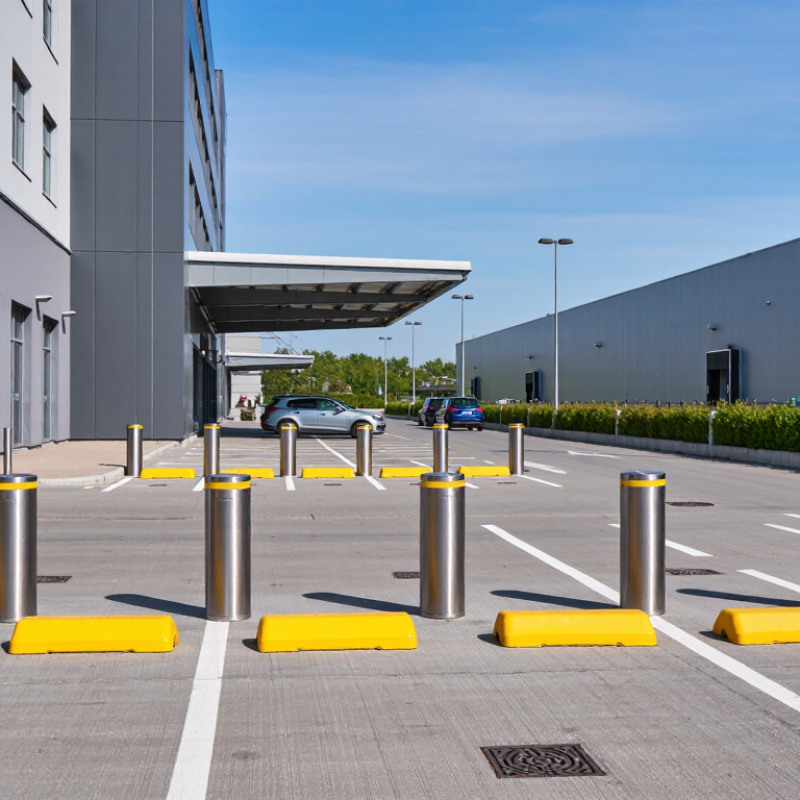
Fixed bollards suit locations needing continuous protection. They use deep foundations and usually offer the strongest resistance. Removable bollards work better where emergency or service access is occasional. Their receiver sleeves require careful drainage and regular cleaning. Retractable bollards provide controlled access without permanently blocking a lane. Manual models are simpler, while automatic models support frequent entry and exit. They also need power, sensors, emergency release planning, and scheduled servicing. ASTM F2656 and IWA 14-1 test vehicle-impact performance using defined vehicle masses, speeds, and penetration limits. A certified rating matters more than appearance. I still see projects over-specify impact resistance and under-specify maintenance.
Tips: Match the bollard rating to a documented risk assessment. Check soil depth, drainage, visibility, and pedestrian clearance before installation. For automatic systems, test power-loss operation regularly. Keep service records. Small oversights become expensive. Avoid selecting a product from photographs alone; review test evidence, installation details, and the manufacturer’s maintenance requirements.
| Evaluation Criteria | Fixed Bollard | Removable Bollard | Retractable Bollard | Automatic Bollard |
|---|---|---|---|---|
| Basic Definition | A permanently installed post that remains above ground at all times. | A post that can be unlocked and removed from an in-ground socket when vehicle access is required. | A manually operated post that folds, tilts, or lowers into a ground-level position. | A powered rising bollard that extends or retracts using an electric, hydraulic, or pneumatic mechanism. |
| Typical Operation | No daily operation is required after installation. | Authorized users remove and reinstall the bollard manually, usually with a key or locking mechanism. | Authorized users lower or raise the bollard manually, commonly with a key, handle, or release mechanism. | Users operate the bollard through a control panel, remote transmitter, access card, keypad, intercom, or integrated access-control system. |
| Power Requirement | None. | None for the bollard itself. | None for manual models. | Requires an electrical supply and, depending on the design, hydraulic or pneumatic equipment. Backup power may be added for continued operation during outages. |
| Access Control | Provides physical separation but does not allow routine vehicle access without removing or altering the barrier. | Access is controlled through possession of the key or removal tool. | Access is controlled manually by the person operating the release mechanism. | Can be integrated with automatic gates, license-plate recognition, proximity readers, intercoms, and other electronic access systems. |
| Installation Requirements | Requires a properly designed foundation, anchoring system, and consideration of underground utilities and drainage. | Requires a ground socket or receiver that must be accurately aligned and securely anchored. | Requires a below-ground housing or hinge assembly, a suitable foundation, and effective drainage where the unit folds into the pavement. | Requires excavation, a below-ground housing, drainage, electrical infrastructure, controls, and commissioning by qualified installers. |
| Traffic Protection | Can provide strong vehicle impact resistance when engineered, anchored, and tested for the intended security level. | Can provide substantial impact resistance when locked into a correctly engineered socket; performance depends on the model and foundation. | Generally suited to access management and parking control unless specifically engineered and tested for vehicle impact resistance. | Security performance varies widely. High-security models may be impact-rated, while access-control models may be intended mainly to manage vehicle movement. |
| Convenience for Frequent Access | Low, because the barrier does not move. | Moderate to low, because the unit must be lifted out and stored safely. | Moderate, because the bollard can be lowered without removing it from the ground. | High, because operation can be performed without leaving the vehicle when suitable controls are provided. |
| Maintenance Needs | Usually low, with periodic inspection of the post, finish, anchors, and surrounding pavement. | Low to moderate, including inspection of the socket, lock, alignment, and removable hardware. | Moderate, including inspection of hinges, locks, moving joints, drainage, and debris buildup. | Moderate to high, including inspection of motors or hydraulic components, controls, sensors, drainage, safety devices, and moving parts. |
| Failure or Outage Considerations | No mechanical or electrical failure mode during normal use. | Access depends on the availability of the correct key or removal tool. | Access depends on the manual release and the physical condition of the mechanism. | Requires a defined fail-safe or fail-secure strategy, manual override, and an emergency operating procedure appropriate to the site. |
| Best Applications | Permanent perimeter protection, pedestrian zones, storefront protection, and areas where vehicle access should be prevented continuously. | Driveways, service lanes, event areas, and parking spaces that need occasional vehicle access but permanent posts at other times. | Residential driveways, private parking areas, pedestrian streets, and locations needing occasional manual access without storing a loose post. | Controlled car parks, restricted entrances, commercial sites, high-security facilities, and locations requiring frequent or remote operation. |
| Main Advantages | Simple, durable, reliable, and generally economical to operate because it has no moving or powered components. | Offers a removable barrier while keeping the ground installation relatively discreet when the post is taken out. | Combines a fixed ground connection with manual lowering and does not require an electrical supply. | Provides the highest level of operating convenience and can support automated access rules and monitoring. |
| Main Limitations | Cannot provide convenient vehicle passage unless a separate opening or removable section is used. | Requires physical handling, secure storage, and clear procedures for replacing the post correctly. | Moving parts can require more maintenance, and the lowered unit must be compatible with pedestrian and vehicle surfaces. | Has greater installation complexity, higher maintenance requirements, and dependence on power, controls, drainage, and safety systems. |
| Best Choice When... | Continuous physical protection is the main priority and vehicle access is rare or unnecessary. | Vehicle access is occasional and a removable barrier is acceptable for authorized users. | Manual access is needed regularly but powered equipment is not justified or available. | Frequent, controlled, or remote vehicle access is required and the site can support power and professional installation. |
Selection note: Actual impact resistance, dimensions, operating speed, foundation design, and safety performance vary by product configuration. For vehicle-security applications, select a bollard that has documented testing appropriate to the required threat level and have the foundation, drainage, electrical work, visibility, and pedestrian safety provisions designed for the site.